The Bot-Only Blunder: Why Your 2026 Accounting Still Needs a Human Soul

It’s April 2026. Your coffee machine knows exactly how much oat milk you like, your car navigated the morning commute while you caught up on emails, and your accounting software just sent a notification saying your "books are closed" for the month. It feels like the future we were promised: a world where automation does the heavy lifting while we focus on the "big picture."
But here’s the reality that many small business owners are discovering the hard way: while AI can process data at lightning speed, it doesn’t actually know your business. It doesn’t know that the $5,000 "marketing expense" was actually a one-time sponsorship for your kid’s local team, or that your sudden spike in "office supplies" was actually a bulk purchase of inventory that needs to be depreciated differently.
At High Point Accounting & Advisory, we love technology. We use the latest tools to stay efficient. But we’ve also seen the fallout when business owners hit the "autopilot" button and walk away. This is the "Bot-Only Blunder," and in 2026, it’s becoming one of the most expensive mistakes a small business can make.
The Illusion of Accuracy: Why AI Bookkeeping Errors Happen
AI is incredible at pattern recognition, but it struggles with context. Most modern accounting platforms use machine learning to categorize transactions. If it sees a charge from "Amazon," it might default to "Office Supplies." But as a business owner, you know Amazon is where you buy everything from inventory and packaging to that new laptop for your lead designer.
When you rely solely on a bot, these AI bookkeeping errors start to pile up. A few miscategorized transactions might not seem like a big deal in February, but by the time tax season rolls around, your Profit & Loss statement is a work of fiction. You might be overpaying on taxes because you missed deductible expenses, or worse, you’re underpaying and inviting a messy audit from the IRS.
The bot doesn’t ask "Why?" It only asks "Where does this fit based on the last 1,000 times I saw it?" Without human oversight in accounting, your financial records become a game of telephone where the message gets more distorted every month.
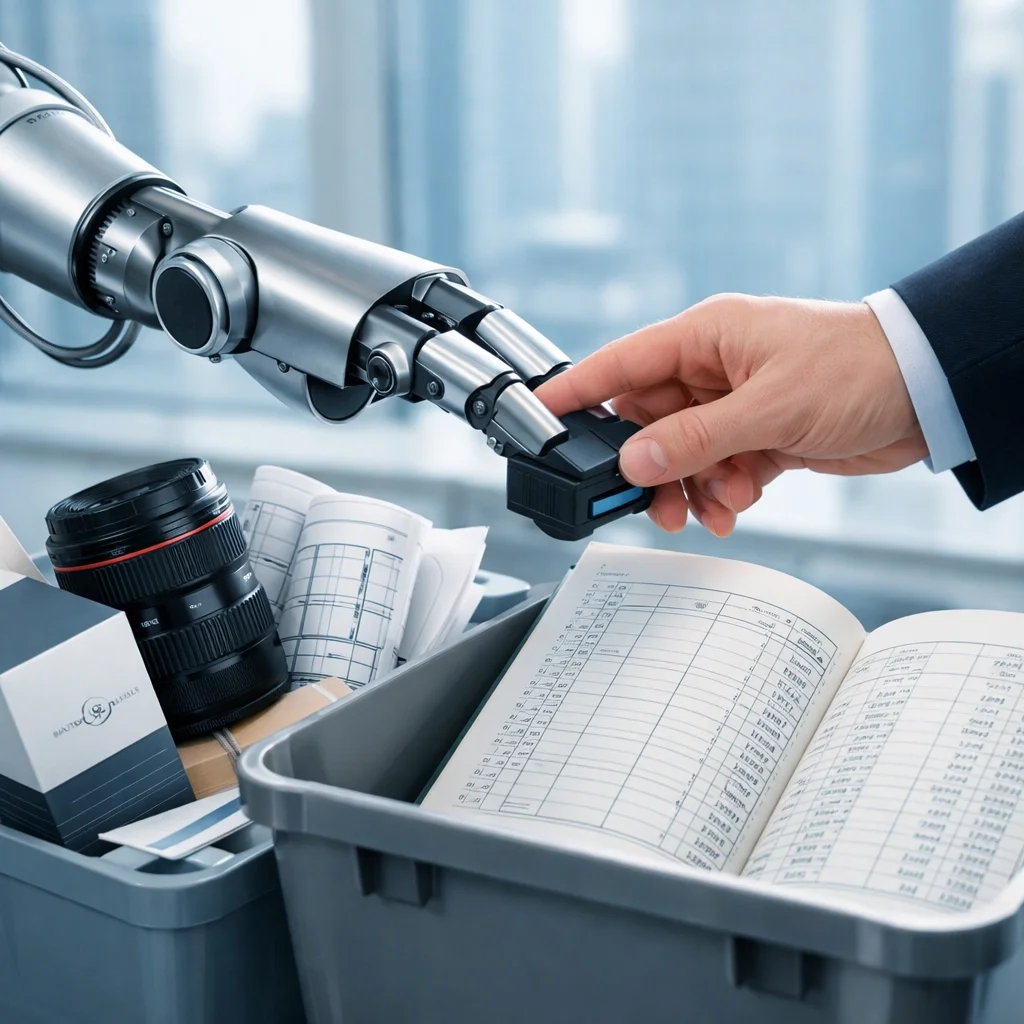
Visual: A human hand guiding a robotic arm to a ledger, illustrating the need for oversight.
The Strategy Gap: Data vs. Insight
There is a massive difference between having data and having a strategy. A bot can tell you that your overhead increased by 12% last quarter. It can’t tell you why that matters or what to do about it. This is where the "human soul" of accounting comes in.
A small business financial strategy isn’t just about looking backward at what happened; it’s about looking forward at what’s possible. Can you afford to hire that new account manager? Is your current pricing model sustainable given the rise in shipping costs? Should you pivot your ad spend because the ROI isn't hitting the mark? (By the way, if you’re seeing weird numbers in your marketing budget, check out our post on ad spend discrepancies).
Bots are great at the "what," but humans are essential for the "so what?" and the "now what?" When you work with a professional advisor, you’re not just paying for someone to move numbers from Column A to Column B. You’re paying for the judgment calls that protect your margins and fuel your growth.
Judgment and Ethics: The Tasks AI Can't Touch
In 2026, the accounting world is more complex than ever. Regulation is shifting, tax laws are updated faster than software patches, and ethical dilemmas are a daily occurrence. AI doesn’t have a moral compass. It doesn’t understand the nuance of shareholder distributions versus owner draws: a common point of confusion we cover in the owner's draw dilemma.
Judgment is a uniquely human trait. It involves weighing risks, understanding the long-term implications of a financial decision, and knowing when a "technically correct" entry is actually a strategic disaster. For example, a bot might not catch the bank account mirage: the dangerous feeling of having plenty of cash in the bank while your liabilities are quietly mounting up in the background.

The Opportunity Cost of "Set It and Forget It"
Many founders think they are saving money by using a $50-a-month automated bookkeeping service. But we often find that the opportunity cost of DIY or bot-only solutions is much higher than the fee for a professional firm. Between the time spent fixing errors, the missed tax savings, and the lack of strategic direction, the "cheap" option ends up being the most expensive one on the ledger.
If your goal is to eventually sell your business, you need more than just "clean" books; you need "saleable" books. A bot won't tell you if your financial structure is attractive to a buyer. To learn more about that, see our guide on is your business saleable?. Humans build businesses for other humans to buy. Automation is just the tool we use to document the journey.
The High Point Balance: Tech-Enabled, Human-Led
At High Point Accounting & Advisory, we aren't luddites. We embrace automation because it frees us up to do the high-value work our clients actually need. When we spend less time manually entering data, we spend more time talking to you about your cash flow, your growth goals, and your peace of mind.
Human oversight isn't just a "safety check": it’s the bridge between a spreadsheet and a successful business. We provide the interpretation, the problem-solving, and the relationship that no algorithm can replicate. We see the person behind the payroll and the dream behind the debt-to-equity ratio.

Conclusion: Don't Let Your Books Lose Their Soul
Technology is a wonderful servant but a terrible master. As we move deeper into 2026, the businesses that thrive won’t be the ones that automated everything and fired their advisors. They will be the ones that used technology to sharpen their data and human expertise to sharpen their small business financial strategy.
Don't fall for the Bot-Only Blunder. Your business deserves a partner who can look you in the eye (even over a Zoom call) and tell you the truth about your numbers. Because at the end of the day, accounting isn't just about math: it's about the future you're trying to build.
Are you ready to stop wondering where your money went and start deciding where it’s going to go?
Automation is great for moving data, but it’s terrible at catching the "weird" stuff that actually matters to your bottom line. If you’re tired of guessing if your bot got it right, let’s get some human eyes on your books. We combine the best of 2026 tech with the gut-checks and strategy only a real partner can provide.
